
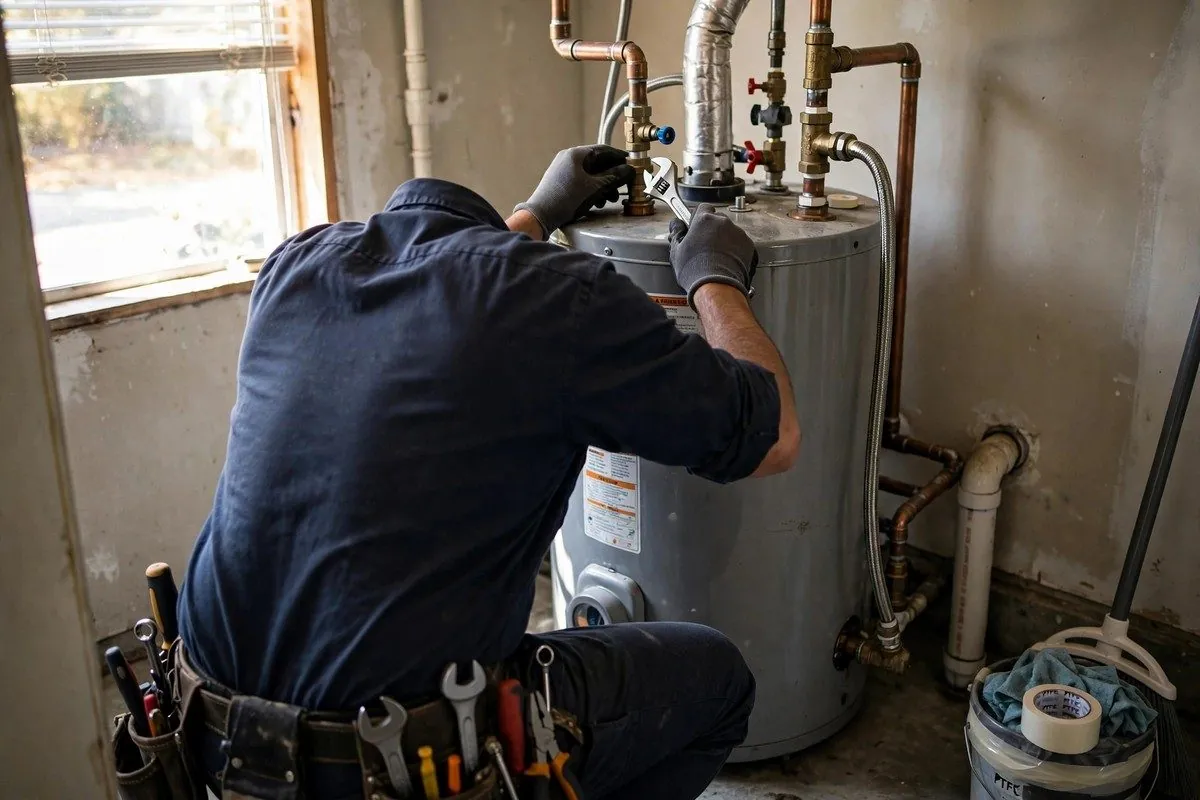
Emergency water heater repair in Haverford
Water heater repair covers the parts that fail before the tank does: heating elements, thermostats, igniters, thermocouples, valves and anode rods. In Haverford, PA a plumber can often fix a no-hot-water problem in a single visit if the tank is still sound.
A repair is worth it when the tank is young and dry. If the tank itself leaks, the page on water heater replacement is the better fit.
No hot water: when to call right away
A cold shower is an inconvenience, but a few symptoms are safety problems. A gas smell, a tripped breaker that keeps tripping, scorching water or a pressure valve that sprays all call for an immediate call.
If you smell gas, leave the house and call the gas utility before anything else. For other problems, the 24/7 line is open and the dispatcher will tell you what to turn off while the plumber is on the way.
Symptoms and likely causes
Different symptoms point to different parts. A plumber confirms by testing, and these are the usual suspects.
No hot water at all, electric
A failed heating element, a tripped high-limit switch or a bad thermostat. All are repairable parts.
No hot water at all, gas
A pilot that will not stay lit, a failed thermocouple or a faulty gas valve, often a quick fix.
Water is lukewarm
One of two elements has failed, or the dip tube has cracked and mixes cold water in.
Water runs out fast
Sediment is taking up tank volume, or one element has quit, so the tank refills slowly.
Cold showers this morning?
Call the 24/7 line. Many repairs finish in one visit.
Common repairs and what they involve
Prices vary by part and brand, so this table shows scope rather than cost.
| Repair | What the plumber does | Often done in one visit |
|---|---|---|
| Heating element | Drains the tank, replaces the element and tests | Yes, if the part is on the truck |
| Thermostat | Replaces the control and sets the temperature | Yes |
| Thermocouple or igniter | Replaces the safety sensor or ignition part | Yes |
| Temperature and pressure valve | Replaces the safety valve and checks pressure | Yes |
| Anode rod | Replaces the rod that protects the tank from rust | Often, depending on access |
The age question
Age decides whether a repair is smart. A tank under eight years old with a failed element is an easy repair. A tank past twelve years with a bad gas valve is often a poor use of money, because the next failure may be the tank.
Check the serial number on the data plate. Many manufacturers encode the date in it, and the plumber can read it for you. If the unit is in the gray zone, ask for a price on both repair and replacement and choose with the numbers in front of you.
Sediment, noise and the flush
A rumbling tank is usually one with sediment baked onto the bottom. The noise is trapped steam bubbling through grit. Flushing the tank can reduce it, but heavily scaled tanks sometimes do not respond.
Flushing is a maintenance task that many homeowners skip, and some tanks respond to it best when it starts early. Ask the plumber what your tank looks like when it is drained, and whether a yearly flush makes sense for you.
Water heater repair cost factors
A repair is quoted after the plumber finds the fault.
What moves the price
Repairs are rarely covered by homeowners insurance, though some home warranties may help. Call (610) 672-7601 for a price before the plumber opens the unit.
Recurring problems that point to something else
If a heater trips its breaker repeatedly or the relief valve drips every day, the cause may be in the house, not the heater. High water pressure, a failed expansion tank or a bad shutoff all produce the same symptoms.
Pressure problems tie into your whole plumbing system, and in some cases a new water heater will not fix them. For a leak that starts at the connections, see leak detection, and for a new tank, water heater replacement.
Questions we hear most
Yes. The 24/7 line takes water heater calls at any hour. The plumber tests the unit and fixes the part if it is repairable, or tells you straight if the tank needs replacing.
On an electric unit, one element may have failed. On any unit, a broken dip tube can also send cold water to the top of the tank. Both are repairable.
It can be a sign of high pressure or temperature. Do not cap it. Call so the plumber can test the pressure and replace the valve if needed.
Many manufacturers suggest a yearly flush, but the right schedule depends on how much sediment your water leaves. The plumber can tell you from what drains out.
Often yes. Failed thermocouples, igniters and gas valves are common, repairable causes. If you smell gas, leave the house and call the gas utility first.
When the tank leaks, when the unit is well past its expected age or when the repair costs a large share of a new tank. Ask for both prices and compare.