
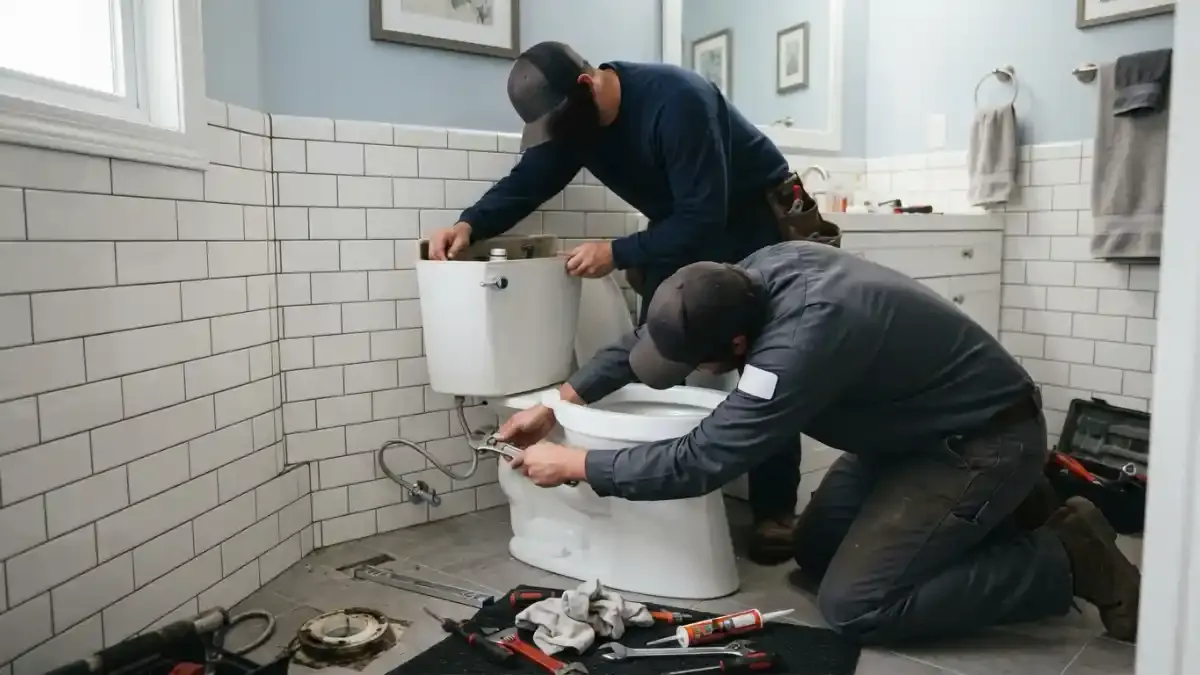
Emergency toilet repair in Haverford
A toilet that overflows, will not flush or leaks at the base is a problem that cannot wait, because it is often your only bathroom. In Haverford, PA the plumber clears clogs, replaces worn parts and, when needed, resets or replaces the toilet itself.
This page covers clogs, running toilets, base leaks and the emergency steps for an overflowing bowl.
When a toilet is an emergency
A bowl rising toward the rim, water on the bathroom floor or a toilet that backs up when you run another fixture all call for a quick response. A running toilet that wastes water all day is not a midnight emergency but it does run up your bill.
If the bowl is rising, lift the tank lid and push the flapper down to stop the flow, or close the shutoff valve behind the toilet by turning it clockwise. Then call the 24/7 line.
Stop an overflow in four steps
Keep these steps in mind before the plumber arrives.
- Close the shutoffThe valve on the wall or floor behind the toilet stops water flowing to the tank. Turn clockwise.
- Lift the tank lidPush the flapper down to stop water entering the bowl.
- Do not flush againA second flush adds water to a full bowl and spreads the mess.
- Mop and ventilateSoak up water quickly and keep children and pets away from contaminated water.
Toilet overflowing?
Close the shutoff valve and call the 24/7 line.
Common toilet problems and what causes them
Most calls fall into a few patterns.
Clog that will not clear
A plunger fails when the blockage is beyond the trap. A closet auger reaches it without damaging the bowl.
Constant running
A worn flapper, a bad fill valve or a chain that is too tight lets water slip into the bowl.
Leak at the base
A failed wax ring or loose closet bolts let water seep out around the floor flange.
Weak flush
Clogged rim jets, a low tank level or a partial blockage in the drain.
Repair or replace
Most toilets are repairable. This table shows the usual breakpoints.
| Problem | Usual fix | Replace the toilet when |
|---|---|---|
| Running tank | New flapper or fill valve | The tank is cracked |
| Base leak | New wax ring and bolts | The floor or flange is badly damaged |
| Frequent clogs | Auger the line and check the drain | The toilet has a poor flush design that keeps failing |
| Cracked bowl or tank | Not repairable | Always |
When the clog is not the toilet
A toilet that clogs again and again, or that gurgles when another fixture drains, is telling you the clog is in the main line. Plunging will not fix a blocked sewer.
In that case the answer is a drain cable or jet, covered in drain cleaning and sewer line cleaning. Do not use liquid drain openers in a toilet, since they can damage the bowl and splash back on whoever opens the line next.
Water use and your bill
A running toilet can waste a surprising amount of water without any sound. A simple test is to drop a few drops of food coloring into the tank and wait ten minutes. If color shows in the bowl, the flapper is leaking.
Replacing a flapper or fill valve is among the most cost-effective plumbing repairs you can make. If your bill has jumped and you cannot find the cause, a leak detection visit can check the rest of the house.
Toilet repair cost factors
Most repairs are quick and priced by the job.
What moves the price
Toilet repairs are normally a homeowner expense. Water damage from a sudden overflow may be an insurance matter. Call (610) 672-7601 for a price before work begins.
What code expects of a toilet installation
The International Plumbing Code, or IPC, and federal water efficiency rules limit how much water a toilet may use per flush. Replacing a toilet with a current model meets those limits, while an old unit may use more than the rules now allow.
If your toilet is decades old and keeps failing, replacing it can lower your water use as well as fix the leak.
When to replace instead
A toilet with a cracked bowl, a failing glaze or a chronic poor flush is usually better replaced than repaired. A newer model also uses less water per flush.
Our plumber can install a standard replacement as part of the same visit. For a bathroom remodel with a toilet move, see plumbing installation.
Questions we hear most
Yes. The 24/7 line takes overflow and backup calls at any hour, and the dispatcher will tell you how to stop the water.
Usually a worn flapper, a bad fill valve or a chain that is too tight. All are quick, inexpensive repairs.
Often a failed wax ring or loose bolts. It can also be a leaking supply line or condensation. The plumber finds which.
No. It can damage the bowl and splash back at the next person who opens the line. Use a plunger or call.
That points to a main line blockage. Call so the line can be cleared with a cable or a jet.
A running toilet is often done in under an hour. A wax ring replacement takes longer because the toilet is pulled and reset.