
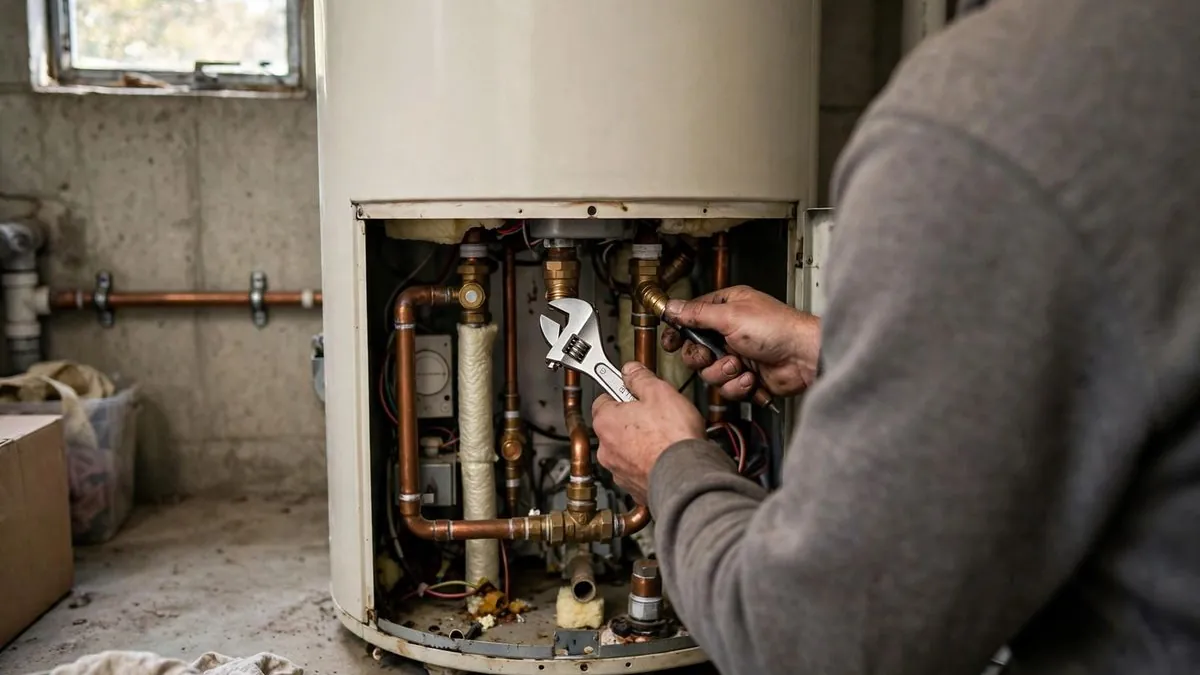
How to replace a water heater element: the short version
To replace an electric water heater element, start by turning off the power at the breaker and confirming it is dead with a tester. Shut the cold supply and drain the tank below the element. Then swap the element with a new gasket, refill the tank fully and only then restore power.
Most Haverford homeowners start this job when they get lukewarm water or run out fast. It is a modest repair, and the one mistake that ruins a new element is turning on the power before the tank is full.
Signs an element has failed
An electric tank has two elements, an upper and a lower. The upper heats the top of the tank and hands off to the lower. When one fails, the symptoms are specific.
A dead upper element leaves you with no hot water. A dead lower element gives you a small amount of hot water that runs out quickly. A tripped breaker or a thermostat that never clicks can look like a bad element too, so test before you buy.
Symptoms and likely cause
A quick diagnostic guide.
| Symptom | Likely cause | Check |
|---|---|---|
| No hot water at all | Upper element or thermostat failed | Test power at the breaker, then the element |
| Hot water runs out fast | Lower element failed | Test the lower element with a meter |
| Lukewarm water | One element weak or thermostat off | Check thermostat setting and element resistance |
| Breaker trips | A shorted element | Test for a ground fault before restoring power |
Tools and parts
Gather these before you drain the tank.
Element wrench
A socket made for the thin-walled element nut. A regular socket can slip and damage it.
Multimeter and voltage tester
To confirm the power is off and to test elements for resistance.
Replacement element and gasket
Match the wattage and the style on the data plate.
Hose and bucket
To drain the tank below the element level.
Replacing the element
Treat the electrical part with respect.
- Kill the powerSwitch off the breaker and test the wires with a voltage tester to confirm they are dead.
- Shut off and drainClose the cold supply, open a hot tap and drain the tank below the element.
- Remove the cover and wiresTake off the access plate and insulation, and disconnect the wires, noting where each goes.
- Unscrew and swapUse the element wrench to take out the old element, install the new one with a fresh gasket and tighten.
- Refill completelyOpen the cold supply and a hot tap until the water runs steadily without air.
- Restore power and testReconnect wires, replace the insulation and cover, turn the breaker on and check for heat in an hour.
Not comfortable around live wires?
Call. An element swap is a quick visit for a plumber.
Haverford Township and electric water heater work
Haverford Township says plumbing work done by contractors is performed by Township-licensed plumbers and inspected under the Pennsylvania Uniform Construction Code. The Building and Codes Department at 610-446-1000 can answer whether a repair like this needs any filing.
We do not state your water hardness from memory. Sediment from hard water is a common reason elements burn out sooner, so ask your water supplier for its report or test your tap before you decide how often to flush the tank.
Never do this
Never turn on the power while the tank is empty. A dry element burns out in seconds. Never work on the heater without testing the wires, because a breaker can be mislabeled. Never mix up element wattage, since a higher wattage can overload the wiring.
If the tank is old, rusty or leaking, a new element will not fix the real problem. That is a case for water heater replacement. For a heater that makes noise, a flush may help, as covered under water heater repair.
Reading the data plate before you buy
The data plate on the tank lists the voltage and the wattage of each element. Match both. Putting a higher wattage element on circuit wiring built for a lower one can overheat the wires.
The plate also shows the tank size and the manufacture date. Many manufacturers encode the date in the serial number. If the tank is near the end of its life, an element is a short-term fix at best.
Checking an element with a meter
With the power off and the wires disconnected, set a multimeter to measure resistance and touch the probes to the two element terminals. A working element shows a modest reading in ohms. A reading of zero or no reading at all means the element is shorted or open.
Also touch one probe to a terminal and the other to the metal mounting flange. Any reading there means the element is grounded and is the cause of a tripping breaker.
After the repair: what to expect
A tank takes time to heat, so give it an hour or more before judging the result. Water at the tap should climb to the thermostat setting, and the breaker should stay on.
If the water is still lukewarm, the thermostat or the second element may be at fault. Keep notes on what you tested and tell the plumber, who can pick up where you stopped.
Electrical rules that apply to this repair
Wiring to a water heater falls under the National Electrical Code, or NEC, as enforced locally. A simple element swap does not change the wiring, but a failed breaker or damaged wire does, and that work belongs to a licensed electrician.
Never bypass a thermostat or high-limit switch. Those parts are safety devices, and the plumbing code expects them to work.
When it is not the element
A bad thermostat, a tripped high-limit switch or a failed dip tube can all mimic an element failure. A plumber tests each part and replaces the right one the first time.
We serve Ardmore and Bryn Mawr as well as Haverford, so a visit is often same-day.
Questions Haverford homeowners ask
A multimeter reading resistance tells you. A good element reads a few ohms. A reading of zero or infinity points to a failed or shorted element.
It varies with water quality and use. Sediment can shorten a lifespan, so flushing the tank helps.
You can, but many plumbers change both if the tank has had heavy sediment, since the second is likely to follow.
No. Draining to below the element level is enough, but the tank needs to be completely full before you restore power.
Probably not for a simple repair, but call the Building and Codes Department at 610-446-1000 to be sure.