
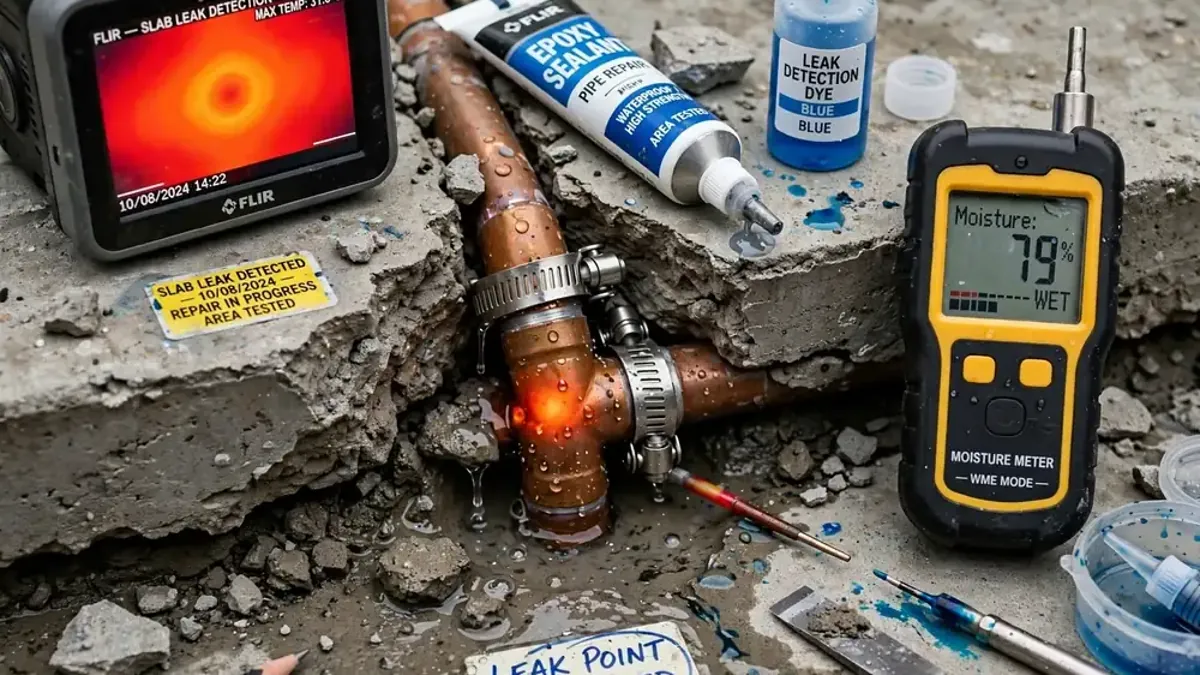
What drives the cost of a slab water leak repair
A slab leak is a water leak in a pipe that runs under or within a concrete floor. The repair price depends on where the pipe sits, how it is reached and what finish materials cover it. We do not post a fixed number, because a leak under a bare basement slab and a leak under a finished floor are very different jobs.
This guide explains the factors, the repair options and how to compare quotes in Haverford, PA.
Do Haverford homes have slab leaks
Many Haverford houses have basements and crawlspaces, so supply lines often run in open space where a leak is easy to reach. Slab leaks are more common in slab-on-grade construction, additions built on a slab or lines that run under a basement floor.
If your pipes run overhead in the basement, a leak there is not a slab leak and is usually simpler to repair. A plumber tells you which you have after a pressure test and a locate.
Signs of a slab leak
The symptoms are consistent.
High water bill
Water is leaving the system while you are not using it.
Warm floor spots
A hot water line leaking under a slab heats the floor above it.
Sound of running water
A hiss or trickle heard with all fixtures off.
Damp flooring or musty smell
Water is reaching the surface somewhere.
Repair options and what changes the price
Each option has a different scope.
| Option | How it works | What drives cost |
|---|---|---|
| Spot repair through the slab | Break a small opening, repair the pipe and patch | Depth, floor finish and size of opening |
| Reroute the line | Abandon the leaking pipe and run a new line overhead or in a wall | Distance, wall and ceiling access |
| Pipe lining | Line the pipe in place | Pipe size, access and condition |
| Replace a larger section | Open more slab and replace pipe | Length and flooring |
Rerouting often costs less than breaking up a finished slab, and it avoids a second repair in the same pipe. Ask the plumber to price both.
High bill and a warm floor?
Call. We confirm and locate the leak before you commit to anything.
Costs beyond the pipe
The plumber's repair is often not the only line on the bill.
Locating the leak
Pressure tests, listening and thermal tools take time.
Floor and finish work
Tile, wood and carpet over the slab are separate trades.
Drying
Wet materials may need drying or removal.
Permits
Some repairs need a permit and inspection.
Permits and insurance in Haverford Township
Haverford Township says plumbing work done by contractors is performed by Township-licensed plumbers and inspected under the Pennsylvania Uniform Construction Code. The Building and Codes Department at 610-446-1000 can say whether your slab repair needs a permit.
The Township's own notice says homeowners policies often exclude sewer, drain and sump pump coverage unless added. For a supply line leak, policies vary, so read yours before the work and ask your agent what is covered, including access costs.
How to compare quotes
Ask each plumber what method they plan, why they chose it and what finish work is included. A quote that lists only the pipe repair and leaves flooring open is incomplete.
Ask also whether the quote includes the locate, a pressure test after the repair and a written warranty. For the detection step itself, see leak detection, and for aging pipes, repiping explains when a bigger plan makes sense.
How to track the leak yourself while you decide
Read your water meter at the same time each day with all fixtures off and write down the numbers. A steady rise tells you how fast the leak is losing water and helps you decide how urgent the repair is.
If the loss is large, shut the main between uses. If it is small, you may have time to compare quotes, but keep checking the floor and walls for signs of damage.
Why rerouting is common
Plumbers often reroute a leaking line through an attic, crawlspace or wall rather than dig up the slab. The new pipe is visible and accessible, and it avoids the old pipe's problem. It also avoids cutting finished floors.
Rerouting adds pipe and wall work, so the price is not always lower. Ask for both options in writing and compare the total, including patching and finishes.
What to document for insurance
Keep photos of the leak area, your water bills before and after, the plumber's report and every invoice. Write down the dates you noticed signs and the dates you called.
Ask your insurer in advance whether access costs and the repair are covered. Some policies cover the damage and the cost of reaching the pipe, and others cover neither.
Warning signs that should not wait
A warm spot that grows, a hissing sound under the floor or standing water around the foundation are signs that the leak is active and getting worse. Cracks in tile or lifted flooring suggest the slab is being undermined.
If you see these signs, shut the main and call. Leaks that run for weeks can erode soil under a slab and lead to larger repairs.
Pressure testing and inspection after a repair
After a repair, a plumber should pressure test the line before it is covered. The plumbing code, including the International Plumbing Code, or IPC, expects tested work before concealment on permitted jobs.
Ask for the test result and keep it with the repair record. It protects you if a later leak raises the question of who is responsible.
What to do while you decide
Shut off the main if the leak is actively wetting the house, and use your meter to track the loss. Photograph damage and keep every receipt. If the leak is slow, you may have time to compare quotes.
We serve Broomall and Drexel Hill as well as Haverford, and our dispatch is open around the clock.
Questions Haverford homeowners ask
Often yes, because water can undermine the floor and run up a high bill. Shut the main if the damage is active and call.
Sometimes. Rerouting the line or lining the pipe can avoid cutting the slab.
A spot repair or a reroute commonly takes a day or two, with extra time for patching.
Policies differ. Many cover the resulting damage and some cover access, but not the pipe. Ask your agent before work starts.
Houses with basements usually have exposed pipes that are easier to repair. Slab leaks are more likely in slab-on-grade houses and additions.