
How leak detection works, in plain terms
Leak detection finds where water is escaping from a pipe without opening every wall. A plumber starts with a pressure test to prove a leak exists, then narrows the location with listening gear, thermal imaging, a moisture meter or tracer gas, and finally opens the smallest possible section to fix it.
If your water bill climbed or a meter turns with every tap off, this is the process that finds the cause. Here is what happens at each stage in a Haverford, PA home.
Step one: prove the leak
Before any tool comes out, the plumber confirms that water is really escaping. The simplest test is the meter check. With every fixture off, a moving meter or a spinning leak indicator means water is leaving the system.
A pressure gauge on a hose bib or a test cap on the supply tells the plumber whether the house holds pressure. A pressure drop means a leak, and by isolating sections of pipe, the plumber narrows it to a zone.
The tools and what each one finds
Each tool answers a different question.
| Tool | What it detects | Where it works best |
|---|---|---|
| Pressure test | Whether a section holds pressure | Confirming and isolating a leak |
| Acoustic listening gear | The sound of escaping water | Under slabs, in walls, in buried lines |
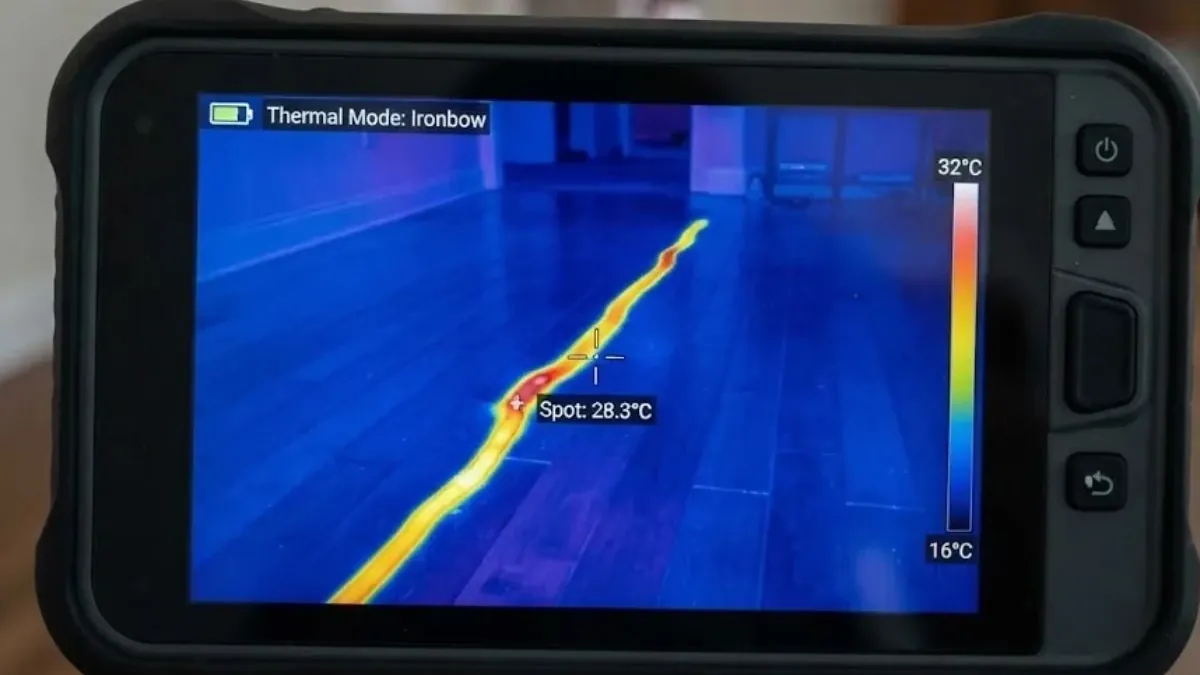
| Thermal camera | Temperature differences from wet material | Hot water lines and wet drywall |
| Moisture meter | Dampness in drywall and wood | Mapping how far water has spread |
| Tracer gas | Gas escaping through a break | Hard-to-pin leaks in sealed lines |
Where hidden leaks tend to be
Each location has its own clues.
Under the floor
A warm spot, a hissing sound or a bill that jumps. Acoustic tools work well here.
Inside a wall
A stain that grows or a musty smell. A thermal camera and a moisture meter pin it down.
Between meter and house
Wet ground, low pressure or a meter that moves with the house off.
At a fixture
A toilet fill valve, a supply line or a heater fitting leaking into a cabinet.
Meter moving with every tap off?
Call. A locate is faster than guessing.
Step two: find the spot
Once the zone is known, the plumber uses listening gear along the pipe. Water escaping under pressure makes a distinct sound, and the sound is loudest above the leak. Marking that spot narrows the opening to a small patch.
Thermal imaging helps when the leak is on a hot line. A warm spot on the floor or wall points to the pipe. Tracer gas is a last resort for sealed lines that will not give up their location.
Water service and utility questions in Haverford
Who is responsible for the water service line depends on your utility and on where the shutoff and meter sit. We do not state your supplier from memory, because service varies by street. Ask your water supplier where its responsibility ends and where yours begins.
For digging near a buried line, call 811 first so utilities are marked. Haverford Township also notes that plumbing work is done by Township-licensed contractors and inspected under the Uniform Construction Code, so ask the Building and Codes Department at 610-446-1000 about permits for repair work.
Step three: repair and verify
Finding the leak is only half the work. The repair depends on the pipe and the location: a spot repair, a replaced section or a larger plan if the pipe is failing everywhere. A second pressure test confirms the fix.
If the pipe is in poor shape across the house, read about repiping. For a pipe that has already split, see burst pipe repair. The service page for leak detection lists what to expect from a visit.
What the plumber will ask you first
The plumber wants to know when you first noticed the problem, whether the bill changed and which rooms feel damp or warm. Photos and bills from the last few months help show when the leak began.
Tell the plumber about recent work in the house. A new appliance, a renovation or a replaced fixture can explain a change that looks like a leak, or it can point right to the source.
How long a search takes and what you pay for
A simple fixture or meter test takes under an hour. A hidden leak in a wall or under a floor can take half a day or more, since each tool narrows the area a little further.
You pay for the diagnosis because it is the hard part. A good plumber explains the findings, marks the location and quotes the repair separately so you can decide what to do next.
When detection is not needed
If the leak is visible, such as a dripping fixture or a wet spot under a sink, you do not need detection. A repair is the right call. If the leak is in a basement with exposed pipes, a plumber can often find it by sight.
Detection earns its price when the water is hidden, the bill is high and the source is unknown. Saying so honestly is part of a good plumber's job.
What you can do before the plumber arrives
Shut the main valve if water is actively damaging the house, and document the damage with photos. Check fixtures like toilets for silent leaks by adding a few drops of dye to the tank.
Move belongings away from wet areas and keep the area ventilated. We serve Ardmore and Drexel Hill as well as Haverford.
Questions Haverford homeowners ask
It is accurate when the pipe is under pressure and the leak is large enough to make sound. A plumber confirms with a second method before opening any surface.
You can check the meter and look for warm spots or damp flooring, but locating the exact spot takes specialist equipment.
Many visits take a couple of hours. Complex or layered searches take longer.
Some policies cover access and detection when there is covered damage. Others do not. Ask your agent.
Your water supplier. Ask the plumber to confirm where the leak sits, then contact the supplier with that information.